June 3, 2026
From Basic to Distinction: Real Star River Student Stories

Picture this: your child sits down at the kitchen table, a Chinese worksheet spread out in front of them. They stare at it for a long time. Then comes the quiet sigh, the one that tells you this isn’t going well.
It is not a lack of trying. Your child goes to school and attends tuition. They sit through practice after practice. But come exam day, the results come back the same. And somewhere between the marking and the silence, a thought creeps in: Is Chinese just not for my child?
That was the reality for many families who eventually found their way to Star River Language School.
Chinese is not a small subject in Singapore. At PSLE, it contributes to the aggregate that determines secondary school options. At O-Level, it sits in the L1R5, directly affecting Junior College and Polytechnic entry. And beyond the grades, a child who feels perpetually behind in Chinese carries that weight into every classroom, every oral exam, and every group discussion in the future.
The good news? Grades are not fixed. And for many Star River students, the turning point came from working differently with an efficient methodology.
What most parents get wrong about Chinese tuition
When a child is struggling with Chinese, the instinct is to do more: more model compositions memorised, more past-year papers drilled, more time spent at the desk. If it isn’t working, surely more of it will help.
This is the assumption that keeps many students stuck.
Here is what that pattern actually looks like in practice: A student spends three weeks memorising a model essay about a school camp. They memorise the vocabulary, the sentence structures, and the opening paragraph. They feel prepared. Then they walk into the exam, see a picture prompt about a neighbourhood fire drill — and freeze. Nothing they memorised fits. They cobble together a generic response, lose marks on structure, lose marks on vocabulary range, and come home defeated.
The problem was never effort. The problem was the method.
Rote memorisation builds familiarity with specific essays, not the ability to understand key points and write compelling essays. Drilling past papers without technique reinforces the same mistakes in a different format. And a tuition centre that simply gives students more of what school already provides is unlikely to shift the needle.
Children were not struggling because they were unteachable. They were struggling because no one had yet shown them the right approach to studying successfully.
A different approach for results
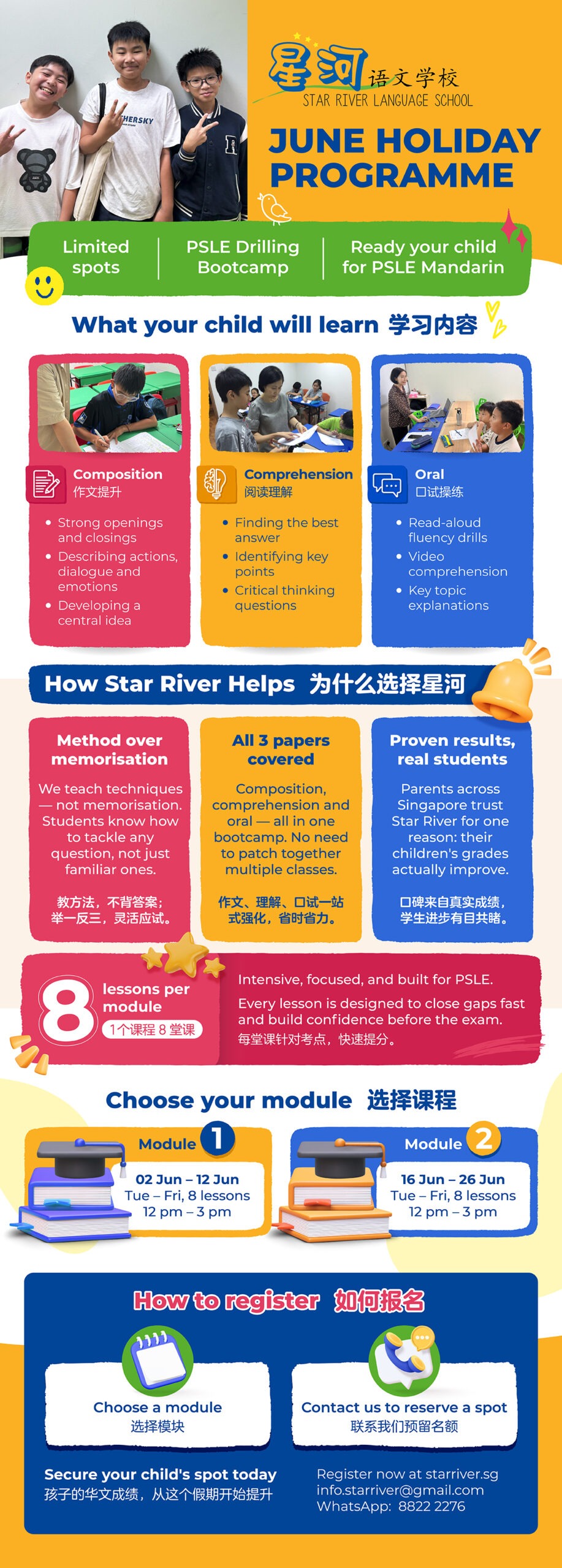
Star River Language School, nestled in Tiong Bahru Plaza and led by Teacher Li Xiu Rong, is built on a single belief: every student can improve in Chinese when they are taught the right method.
Teacher Li, the author of the best-selling ‘I Am the Best in Composition’ and ‘I Am the Best in Comprehension’ series, does not teach students what to write. She teaches them how to write. She teaches them how to convey feelings and messages on paper, with adequate linguistic understanding of the question.
The difference sounds small. The results are not.
Instead of memorising model essays, students at Star River learn how to build any composition from scratch using a structured framework. They practise describing movement, dialogue and emotion using a rotating bank of vocabulary, not a fixed list of phrases.
In comprehension, they are trained to identify the key point and answer with precision, not to copy from the passage. In oral, they learn to engage with real-world topics, not to recite rehearsed lines.
The proof of this method is not in the curriculum. It is in the students.
Take the story of Shijie, who was in Primary 4 when she was told she would never pass Chinese—a moment that deeply affected her confidence. Determined not to give up, she enrolled in Star River Chinese Language School in Primary 5.
With patient guidance and consistent support, she gradually regained interest in the language and achieved AL2 in her PSLE. Although she struggled again in secondary school, her teacher’s dedication helped her rediscover her motivation, turning reluctance into genuine engagement.
Today, Shijie is pursuing Chinese Media studies at the university. She shares, “Thank you for your help over the years. Without you, I might still be scoring F9.” Her journey shows how the right Chinese tuition in Singapore can truly transform a student’s confidence and future.
What you can do right now
If you recognise your child in any part of what you have read, here are four practical steps to take today.
1. Audit how your child currently studies Chinese.
Are they memorising model essays? Copying comprehension answers without understanding the reasoning? Spending hours on past papers without knowing why they lose marks? Identify the habit before changing anything else. The method is where most families find the answer.
2. Have a conversation about confidence, not just grades.
Ask your child directly: “If you saw a composition topic you had never seen before, would you know what to do?”
Their answer tells you whether they have been given a method or just content. A student who knows the method answers yes. A student who has been memorising answers no.
3. Look for a programme that builds ability, not dependence.
The right tuition should make your child more capable of handling unknown questions over time, rather than relying on familiar material. If a tuition centre’s approach would fall apart the moment the exam question looked slightly different, that is worth knowing now.
4. Read what other families have experienced.
Before making any decision, read the stories of Star River students who started exactly where your child is now. Their experiences are the most honest signal of what is possible.
“My child already has too many activities. One more class will stress them out.”
A child who is failing Chinese is already carrying stress. The quiet kind that shows up as avoidance, short answers, and that kitchen-table sigh. The right tuition does not add to that burden. It reduces it by giving your child a method that makes the subject feel manageable rather than impossible.
Star River students consistently describe the classes as encouraging and energetic. For many, it becomes the Chinese tuition lessons they actually look forward to.
“We have tried tuition before, and it did not work.”
This is the most common concern, and it is worth taking seriously. If previous tuition was offering more of the same content-heavy, memorisation-focused approach, the result would be the same regardless of how many hours are invested. What successful Star River students have in common with your child is not that they tried harder. It is that they tried differently.
“Results like these are probably for students who are already strong.”
Teacher Li’s founding belief is that no student is left behind. Some of the most significant transformations in the school’s history began with students who were well below grade level when they first walked in. Improvement is a function of method, consistency, and a teacher who genuinely believes in the student in front of them.
What it comes down to
Weak Chinese grades are not a verdict on your child. They are a signal that the current approach is not working, and approaches can change.
The students in these stories did not suddenly become different children. They were shown a better method by a teacher who knew how to deliver it. Their composition scores improved because they learned how to build an essay, not because they memorised the right one. Their comprehension marks rose because they were taught to read with precision, not to search and copy. Their confidence in oral grew because they practised real discussion, not rehearsed lines.
Your child’s studying journey is not finished yet. The next chapter could look very different, and it might start with a single lesson.
Take the next step
If you would like to read more stories from families who have been through this journey, the Star River testimonials page is the place to start. These are real accounts from real parents, unedited, and in their own words.
Read student testimonials: starriver.sg/zh/students-testimonials/
If you are ready to find out whether Star River is the right fit for your child, the team is available to answer questions and explain current class schedules and availability.




 302 Tiong Bahru Road, #02-144 Tiong Bahru Plaza, Singapore 168732
 TEL 6271 0064
 info.starriver@gmail.com