
June 24, 2026
The Method Behind the Book: How Li Laoshi Teaches Kids to Write Chinese That Examiners Love
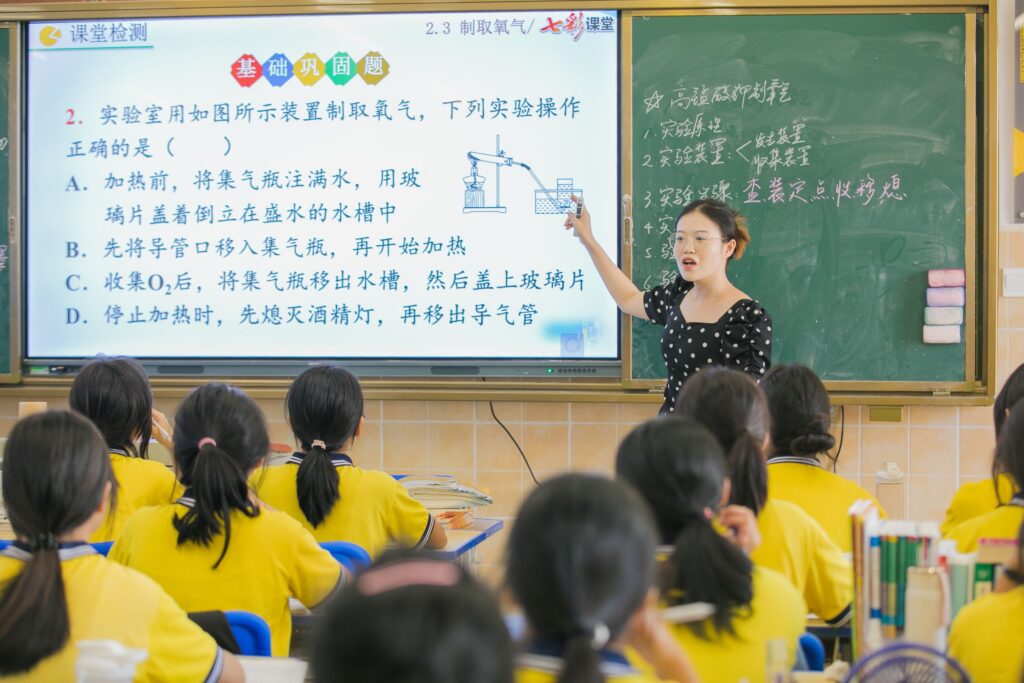
Parents in Singapore know that Chinese composition can make or break a child’s result, especially when the paper demands clear structure, relevant and strong language under time pressure. For many students, the problem is method: they write a lot, yet the writing still feels flat or repetitive.
The ideas are there, but they do not connect. The vocabulary and the structure exist, but it does not feel purposeful. Parents look at the marked script and wonder: they put in the hours. Where did the marks go?
Teacher Li Xiu Rong — head of Star River Language School and author of the best-selling I Am the Best in Composition series — has spent more than two decades asking why so many students find Chinese composition difficult despite genuine effort.
Her answer, distilled into both her books and her classroom practice, is that most children are taught what a good composition looks like. Very few are taught how to make one.
Effective Chinese composition instruction, as described across local curriculum resources, centres on planning before writing, building strong openings and endings, developing a personal vocabulary bank, and rewriting after feedback. These are active habits. They require the student to think, decide, and revise. None of them can be replicated by reading another model essay.
Teacher Li’s observation from more than twenty years in the classroom confirms this. The students who write well are not always the ones with the largest vocabularies. They are the ones who have internalised a repeatable method, who know what to do when they sit down in front of a blank page, regardless of what the question wants.
The method is teachable. Most students have simply never learned how to apply it.
Plan, draft, improve, and reuse
Li Laoshi’s method should be framed as a shift from “memorise and repeat” to “plan, draft, improve, and reuse.” Singapore tuition resources describe effective composition teaching as a combination of outline planning, strong openings and endings, vocabulary banks, and guided rewriting after feedback.
A strong article section can show this with a simple case study: a child who once started every story with the same generic opening learns to use a 5W1H or STAR-style outline, writes a more focused plot, then revises the composition after marking to strengthen language and coherence.
Step 1: Plan before you write
Before a single sentence is written, students are taught to outline their composition using a structured framework. Teacher Li uses a 5W1H approach: Who, What, When, Where, Why, How, adapted for picture or scenario prompts. This simple step transforms the blank page from a source of anxiety into a set of decisions already made. The student knows who is in the story, what happens, and in what order, before the clock starts running on their language choices.
Step 2: Master the opening and ending
The opening and ending of a Chinese composition carry disproportionate weight with examiners, and they are the sections most students handle worst. Teacher Li teaches students not to begin with generic scene-setting, but with a moment of tension, a sensory detail, or a character already in action. The ending is taught as a return to an image, a feeling, or a detail from the opening that gives the essay a sense of shape rather than a sudden stop. Both are practised independently, in short focused exercises, before they are combined into a full essay.
Step 3: Build vocabulary that can be reused
Rather than memorising phrases attached to specific model essays, students build a personal vocabulary notebook organised by theme: action words, emotion words, connectors, and sensory descriptions. These words belong to the student, not the essay. They can be deployed in any composition, adapted to any prompt, and recalled under exam pressure because they have been practised in multiple contexts rather than memorised in one.
Step 4: Rewrite after feedback
This is the step most students skip and the one that produces the most durable improvement. After a composition is marked and returned, Teacher Li’s students are required to rewrite it: not to copy the corrections, but to rethink the weak sections using the technique they have been taught. This turns every marked essay into a learning opportunity rather than a closed result. Over time, the rewrites become faster, and the original drafts become stronger, because the student is internalising the method through practice rather than passive exposure.
Five habits that make a difference
These are the practices Teacher Li recommends to parents and students who want to improve Chinese composition results, not through more hours, but through smarter effort.
1. Build a weekly Chinese vocabulary notebook.
Organise it by theme: emotions, actions, weather, family, school. Add connectors and transitional phrases. Revisit and use the words in short writing exercises so they move from the page to the student’s active vocabulary.
2. Train children to outline first using 5W1H.
Before writing any composition, whether a timed practice or a homework exercise, spend five minutes on an outline. Who is in the story? What happens? When and where? Why does it matter? How does it resolve? Five minutes of planning prevents thirty minutes of wandering.
3. Practice openings, endings, and single paragraphs, not only full essays.
A student who practises five different openings in one sitting builds more skill than a student who writes one full essay. Short, focused exercises on the hardest parts of the composition, the beginning and the end, are more efficient and easier to sustain as a daily habit.
4. Review corrected compositions and rewrite the weak sections.
When a marked composition comes home, do not file it away. Sit with the child and identify the two or three weakest sentences. Ask them to rewrite those sentences using better vocabulary or a stronger structure. This single habit, done consistently, produces more improvement than any amount of additional full-essay practice.
5. Use model essays to study structure
Model essays are valuable teaching tools when used correctly. Read them to understand why the opening works, how the middle develops, and what the closing achieves. Ask: what decision did the writer make here, and why? Then apply that decision to an original essay. This is how model essays build skill rather than dependence.
Good Chinese composition is a repeatable method
The children who write Chinese compositions that examiners remember are not the ones who memorised the most phrases or read the most model essays. They are the ones who learned to think clearly before they wrote, to make purposeful decisions at every stage of the composition, and to improve from every piece of feedback they received.
This is exactly what Singapore’s Chinese composition curriculum has always pointed toward and what Teacher Li has built her teaching practice around for more than two decades. The books are a starting point. The classes are where the method becomes a habit.
If you want your child to write Chinese composition with more confidence and exam-ready structure, the place to start is not another model essay. It is a method any student can apply to any topic, in any exam.
Teacher Li’s I Am the Best in Composition series is available in Singapore bookstores and is a good first step for parents who want to see the method before committing to a class. One chapter is enough to give your child one concrete Chinese composition technique they can use in their very next essay.
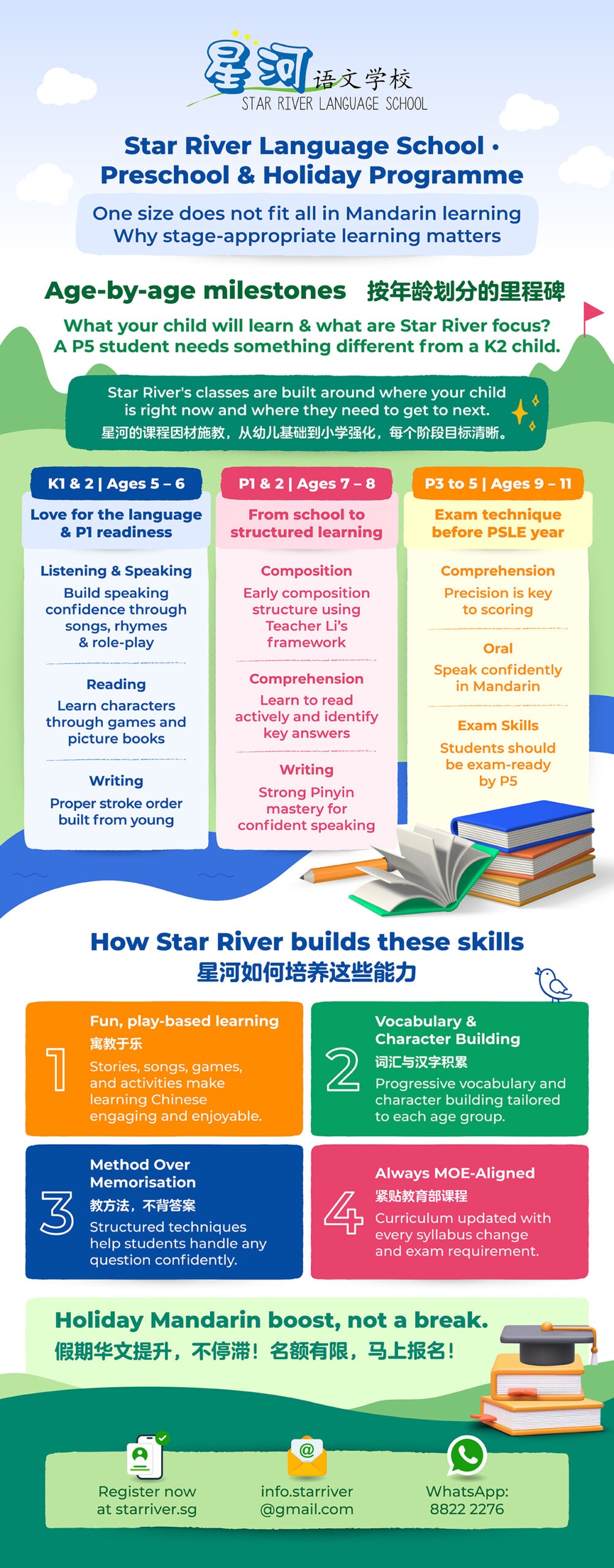
For parents who are ready to take the next step, Star River Language School offers primary Chinese tuition from P1 through to PSLE year, personally guided by Teacher Li Xiu Rong. To find out about current class availability and schedules:
Star River Language School
302 Tiong Bahru Road, #02-144 Tiong Bahru Plaza, Singapore 168732
Tuesday to Friday: 1 pm – 9 pm · Saturday & Sunday: 9 am – 6 pm
WhatsApp: 8822 2276 Email: info.starriver@gmail.com Web: starriver.sg





 302 Tiong Bahru Road, #02-144 Tiong Bahru Plaza, Singapore 168732
 TEL 6271 0064
 info.starriver@gmail.com