
August 13, 2026
Why a Good Mandarin Teacher Matters More Than Ever in Singapore
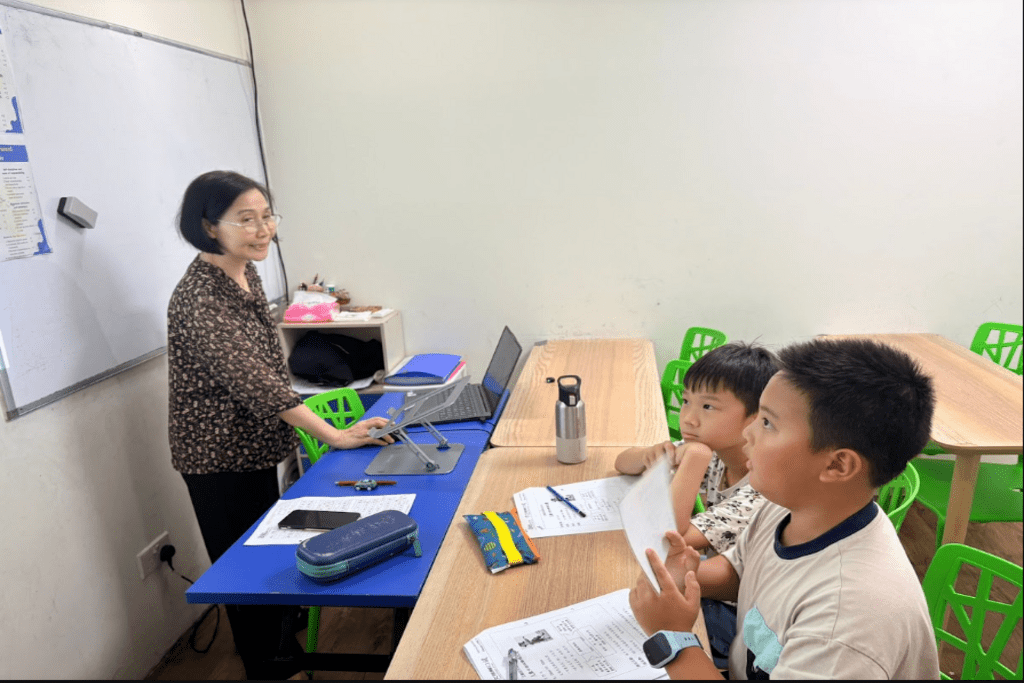
A good Mandarin teacher matters more now than a decade ago because Singapore children simply get less Mandarin exposure at home than they used to. According to Singapore’s 2020 Census, English overtook every other language as the one most frequently spoken at home, rising from 32.3 percent of households in 2010 to 48.3 percent in 2020, while Mandarin use at home fell from 35.6 percent to 29.9 percent over the same period. When a language is fading from daily life outside the classroom, the classroom itself, and the teacher standing in front of it, carries far more of the weight of actually building that language. A weak or inconsistent teacher used to be a setback. Today it is closer to the only chance a child gets.
The rest of this article looks at where that shift comes from, what it means in practice for parents choosing tuition, and what genuinely separates a good Mandarin teacher from an adequate one.
What actually changed, and how quickly
The shift in home language use in Singapore did not happen overnight, and it is not a matter of opinion. It is documented in the government’s own census data. Research from the National University of Singapore, summarised by its Faculty of Arts and Social Sciences in February 2026 and drawn from a peer-reviewed study published in Current Issues in Language Planning, traces this shift back further than most parents realise.
Much of the groundwork was laid by the 1979 Goh Report, led by then Deputy Prime Minister Goh Keng Swee, which identified ineffective bilingualism as a weakness in Singapore’s education system at the time. The response was to reduce the language exposure time given to Mandarin and other mother tongue languages in favour of a stronger English-medium environment. That decision solved a specific problem in 1979. Four decades later, it is a meaningful part of why Mandarin has receded at home.
The government has not ignored the resulting gap. The Committee to Promote Chinese Language Learning was established in 2005 specifically to build community support for Mandarin outside the classroom, and schools have run Mother Tongue Language fortnight programmes since 2011 to create more immersive exposure during the school term. Both point to the same underlying fact: policymakers already recognise that classroom teaching now has to do more of the work that home environments used to share.
Why this raises the stakes for teaching quality
When a child heard and spoke some Mandarin at home as a matter of course, an average teacher could still produce a reasonably competent student, because the language was being reinforced daily outside class regardless. That safety net has thinned considerably. For a growing number of Singapore children, formal lessons are now the primary, and sometimes the only, place Mandarin gets built at all.
This changes what a teacher actually needs to do well. It is no longer enough to cover the syllabus and mark homework. A teacher now has to build vocabulary that has nowhere else to be reinforced, correct pronunciation that will not be corrected again at the dinner table, and create enough genuine engagement that a child chooses to keep trying at a language that increasingly feels foreign rather than familiar.
A teacher who cannot do that consistently, over months and years rather than in one memorable lesson, leaves a measurable gap that used to be quietly filled at home.
What “good” actually means in a Mandarin teacher
Fluency in Mandarin is the minimum bar, not the differentiator. Most tutors clear it. What separates a genuinely good Mandarin teacher from an adequate one tends to come down to a handful of specific things.
They teach the mechanics of the language, not just vocabulary. A good teacher explains why a sentence works, how a particular idiom or structure fits a specific context, and how to build an original sentence rather than recite a memorised one. This matters most in composition, where students need to construct original writing under exam conditions, not reproduce something they learned by heart.
They stay with a student long enough to notice a pattern. A recurring mistake, in grammar, in comprehension technique, in oral confidence, is only visible to a teacher who sees the same child regularly over an extended period. A rotating cast of relief tutors cannot offer this, no matter how individually skilled each one is.
They can explain the current exam format, not an outdated one. Singapore’s MOE Chinese Language syllabus has been revised over the years, including a shift toward greater weight on oral and listening ability. A teacher still working from an older version of the syllabus, however experienced, is preparing a child for a test that has moved on.
They build genuine engagement, not just compliance. Given how much less reinforcement Mandarin gets outside class now, a teacher who makes lessons something a child wants to attend is doing meaningfully more than one who is merely tolerated.
A genuine shortage, not just a perception
Parents sometimes assume a good Mandarin teacher should be easy to find in a bilingual country like Singapore. The reality of the local teaching market says otherwise. Singapore’s own school system reflects this: government schools generally prioritise hiring Singaporean citizens and permanent residents, but foreign teachers are sometimes brought in on contract specifically for subjects facing a shortage of qualified local candidates, and Chinese language is one of them.
That shortage plays out differently outside the MOE system, in private tuition, but the underlying scarcity of genuinely strong Mandarin teaching talent is the same. A tuition centre with a stable, experienced Chinese-language teaching team is not a minor convenience. It reflects a real recruitment advantage that not every centre has managed to build.
How Star River’s teaching approach responds to this
Star River Language School was built around exactly this problem. Our teachers are experienced Chinese-language educators, most trained in Language and Literature or the Performing Arts at university level in China, and they are chosen specifically for their ability to teach composition and comprehension in depth, not simply to converse in Mandarin.
Founder and principal Mdm Li Xiu Rong has spent more than twenty years teaching in both China and Singapore, and wrote her own MOE-aligned composition assessment book series, which went on to become one of Singapore’s best-selling Chinese titles. Her approach, explained in more detail in our article on how Li Laoshi teaches kids to write Chinese that examiners love, centres on teaching a repeatable method rather than handing students model answers to memorise.
Classes at our Tiong Bahru centre stay deliberately small, and the same teachers stay with their classes across the term rather than rotating, which matters directly for the reasons outlined above. This applies across our primary and secondary programmes alike, since the value of a consistent, well-trained teacher does not change with a child’s age, only the stakes do.
What to ask when assessing a Mandarin teacher
A few direct questions cut through marketing quickly, whichever centre you are considering. How long has this specific teacher been teaching Chinese, and where did they train? Will my child have the same teacher for the term, or a rotating roster? How does this teacher handle a student who is not improving, rather than one who already is? And can the centre describe, specifically, how its teaching approach has adapted to the current MOE syllabus rather than an older version of it. A centre confident in its teachers should answer all four without hesitation.




 302 Tiong Bahru Road, #02-144 Tiong Bahru Plaza, Singapore 168732
 TEL 6271 0064
 info.starriver@gmail.com
Leave a Reply